
There are historical moments when language is strained but holds. Revolutions, wars, economic collapses – each demands new vocabularies, sharper metaphors, more imaginative commentary. Yet even in those crises, writers trusted that carefully chosen words could still rise to meet reality. The present age feels different. Each headline brings a shock that defies ordinary language. To describe anything accurately today feels like minimizing it – not because the description is wrong, but because no description can do justice to the preposterousness of it all.
In the Trump era, everything I write is an understatement.
Political commentary presumes a shared scale on which we make judgements. It assumes exaggeration is possible and that outrage can be expressed in simple words that can be understood. And that this scale has an upper boundary of shock. But we have crossed this boundary. The grotesque and the unprecedented has become part of our daily life. We are in new territory, or rather in another solar system. It feels as if we have entered a science fiction movie that introduces new elements every few minutes that we must struggle to make sense of. And as soon as we think we get it, a new parallel plot appears in some other corner of the galaxy, and then another one, each with its own last-minute twists.
In the Trump era, the common reality we all once shared has vanished.
And it has not been replaced by a new one that we may attempt to understand and “enter.” Political reality is shifting every day with new absurdities. Putin is welcomed in the US with a red carpet, while Zelensky (a larger-than-life figure admired by the vast majority of other world leaders) had to settle for a private visit at the president’s Palm Beach golf club, as if he were a nuisance interrupting the president’s game. Tariffs, an early twentieth century relic, have taken center stage as a weapon of revenge on those who do not cooperate with the president. The streets of American cities have been flooded with ICE agents who abruptly grab people going about their daily lives. And when people react, these agents kill, as was the case with Renée Good, an American poet, whose only crime was being in her car peacefully protesting, and last Saturday, with Alex Jeffrey Pretti, a nurse who worked in a veterans’ hospital. The president of Venezuela was abducted in the middle of the night … just because (as internal transcripts have revealed) Trump got angry that Maduro mocked him by imitating his dancing! And Denmark and Greenland were about to be invaded because the president decided he wants Greenland (or is it Iceland?!) … after he tried to convince Canada to become the USA’s 51st state! And the European countries that reacted to this were threatened with “retaliatory tariffs.” He abuses journalists nonstop, and recently he even raised his middle finger at a heckler – yes, this too has happened! Not to mention the discovery and publication of his scandalous typewritten message to Jeffrey Epstein, framed by the outline of a nude woman with Trump’s signature sketched to resemble her vagina. But the most shocking of all (oh, “shocking” … what a poor and ordinary word, yet again) was Machado handing over her Nobel Peace Prize to Trump and that disgusting photo with them posing in the Oval Office. It was no prank gift, and despite Trump’s grin, it was not a satire piece from The Onion!
And as if all these were not enough, the president tells us his thoughts in … real time. He tweets through the night, making public his every fleeting impulse and petty grievance as it arises: He attacks his opponents, he brags about his accomplishments, he reposts praise directed at himself, he amplifies fringe conspiracy theories, he provokes, bullies, vents his anger. Some psychiatrists have characterized him as a “malignant narcissist,” but let’s not go there. More recently, he even started sharing his emails and message exchanges with world leaders – private conversations that were never meant to be made public.
Failing Words
The daily hyperbole has become so ordinary that words like “dangerous,” “unprecedented,” or “norm-shattering,” which once signaled genuine alarm, now sound banal. Each new event demands a stronger adjective, but constant exaggeration erodes their force. The result is a paradox: The more extreme reality becomes, the flatter our descriptions feel. We experience outrage fatigue. When every week is described as a “constitutional crisis,” eventually nothing feels particularly crucial. The more we insist “this is not normal,” the more normal it sounds.
There is also the problem of disbelief. Even when events are described accurately, they resist assimilation into the reader’s mental model of how a democracy is supposed to function. The mind pushes back: “This cannot be happening,” “There must be more context,” “Surely the system will correct itself.” What is written feels smaller than what has occurred, because the reader’s outrage is so much stronger. A headline reads “US President Contemplates Using Force to Take Greenland” and the reflex is to treat it as hyperbole or a joke. Our inner voice adds an asterisk: “Surely he didn’t mean it literally.” But we soon discover he did! Reality has outstripped the reader’s capacity to believe, so we live in a state of semi-denial. The writer’s boldest depiction feels like an understatement because the truth itself is unbelievable. Faced with this, some writers use increasingly rising excess, hoping it will substitute persuasion. But such a strategy is already failing. Others abandon analysis altogether, opting for slogans or brief comments under various articles or in videos on TikTok, YouTube, and Facebook. Others, myself included (well, … until today!), choose to remain silent because we feel that whatever we write will be an understatement.
Perhaps the only redeeming path is simple political irony. And The Onion has taken exactly this path: It amplifies the preposterousness to its … irrational conclusion in a vain attempt to wake us up! In the following “news item,” relating to the president publicly raising his middle finger to a heckler during a recent visit at a Ford plant titled “Pundits Praise Strength, Dexterity Required for Trump to Successfully Lift Middle Finger,” we are not sure whether what is attributed to Sean Hannity is true, exactly because it sounds like something he could have said:
Lauding the commander-in-chief’s response to being heckled at a Ford plant as a stunning physical feat, pundits from multiple media outlets praised President Donald Trump on Thursday for summoning the strength and dexterity necessary to successfully lift his middle finger. “The obscene gesture Trump made in Michigan was brimming with youthful vitality, not to mention quite a bit of technical finesse,” said Fox News’ Sean Hannity, echoing the sentiment of dozens of political commentators who remarked that the 79-year-old Trump had flipped the bird with the deftness and vigor of a man half his age. “No president since Teddy Roosevelt has possessed the raw bodily prowess required not only to lift his middle finger, but also to hold it in the air – completely unassisted – for nearly a full second. Most leaders would struggle to flip someone off as effortlessly as Trump did, and none of them could pull it off while walking with such bold, muscular steps. It borders on superhuman, but that’s just the kind of athleticism you come to expect with such an incredible physical specimen leading our country.” Hannity went on to commend the mental acuity and “rapier wit” that allowed Trump to come up with a retort for the heckler as scathing as “Fuck you.”
When an Onion news item reads as plausible, it is a sign that Camus’s absurd has become America’s new reality.
Meagre Opposition
But how are all these things allowed to happen in a democracy?
Unfortunately, the US has no formal political position equivalent to a “Leader of the Opposition” as in most other democracies, because the constitutional system is presidential, not parliamentary. In parliamentary systems (e.g., the UK, France, and most of Europe), the executive emerges from the parliament, and the opposition is institutionally recognized and expected to publicly scrutinize the government. The leader of the largest nongoverning party speaks as “the opposition,” responds to government statements, and confronts the prime minister in parliament. In the US, the executive is separate from the legislature. The president is elected independently of Congress, so there is no official counterpart whose job is to oppose the government. Party leaders in Congress (Senate or House minority leaders) are legislators, not alternative heads of government, and they speak only for their caucus – not the nation. As a result, the opposition in the US is fragmented, informal, and expressed through individual press statements, congressional hearings, and personal activism rather than as an institutional process. Therefore, the role of the “opposition” is taken up by only a handful of senators and governors, most prominently these days by Gavin Newsom, Adam Schiff, and the tireless 84-year-old Bernie Sanders.
Flooding the Zone with Shit
But all these events hitting us simultaneously, although apparently random and chaotic, are actually based on the philosophy of “flooding the system,” whose father is none other than the political operative Steve Bannon, the architect of Trump’s first term election victory. According to him, since there is no political opposition in the US (as explained above), so the real opposition is the media, and the best strategy to fight them is to launch multiple storylines or controversies rapidly so that outlets – and therefore public attention – never settle long enough on any one issue to scrutinize it closely.
This is what he had to say about it in a 2018 interview with Michael Lewis:
The real opposition is the media. And the way to deal with them is to flood the zone with shit! All we have to do is “flood the zone.” Every day we hit them with three things, they’ll bite on one, and we’ll get all of our stuff done. They’ll never be able to recover.
The goal is to launch so many storylines that journalists and citizens never focus long enough on any one of them. One outrageous statement or scandal dominates the news cycle, pushing the last one off the front page, and before the new one sinks in, another has replaced it. And here you have it: shit hitting the fan every single day so nobody can get a hold on any of it!
Trump’s continual lying is so off the charts that it has become tragicomic. In last week’s 70-minute-long rambling speech in Davos, he spit out so many lies that even the prestigious BBC felt it had to debunk, well, some of the shit: The US used to own Greenland and it gave it back to Denmark after WWII (completely made up); China has no wind farms (China generates more wind energy than any other country – its largest wind farm in Gansu can actually be seen from space!); the US gets nothing back from NATO (the US is actually the only country ever to invoke Article 5 of the alliance, requesting that all countries help it after the 9/11 attacks). In that same speech, Trump taunted the US allies about World War II, saying that “without us, right now you’d all be speaking German and a little Japanese perhaps” – thus spake in … German-speaking Davos! Nobody ever told him that the Soviet Union had by far the largest contribution to the victory of the Allied forces in WWII – they lost 7.5 million soldiers whereas the US “only” lost 400,000.
Probably the pinnacle of Trump’s utter ahistoricity (struggling with the creation of new words here, inspired from the Greek – ανιστόρητος!) was in 2019 when he said that the Continental Army took over airports during the American Revolution (in the … eighteenth century)! I wonder if he has ever read a single book in his life.
Oversized Baby
Well, shit points to diapers and babies, who often play with shit (as I too once did according to my mom!). Trump’s childish behavior often reminds me of the oversized infant in the Cirque du Soleil show Mystère that I happened to see on three separate occasions in Las Vegas. In Mystère, an infant, who is played by an adult, is the protagonist of the show and enters multiple times to disrupt the stage with comedic skits. The infant adult enters the stage holding a giant ball while waddling, throwing tantrums, and demanding attention. It is noisy, gluttonous, erratic, needy, self-absorbed, and uncontainable. Trump’s behavior is similarly inflated, impulsive, performative, repetitive. Like the overgrown baby, he interrupts processes, derails conversations, tramples norms, and substitutes noise for conversation. His tweets function like tantrums: loud, provocative, attention-seeking. Trump’s refusal to “mature” is reframed by his supporters as authenticity; his lack of self-control supposedly shows strength; his infantile repetitions (“many people are saying,” “tremendous,” “fake news”) are deemed political emphasis. And of course, for the time being, just as a baby, he is never held responsible. His excesses and verbal outbursts are framed as “his personal style,” not a failure of character.
In both cases, caretakers emerge – “handlers” who rush in to interpret the cries as intentions and the tantrums as strategy. One of the most shocking things we have witnessed was in the recent meeting with top oil and gas executives at the White House – gathered to discuss the exploitation of Venezuela’s oil reserves, which in itself was something out of Orwell’s 1984. At some moment, Trump’s attention wavered. He walked to the window, pressed close to the glass, and began commenting on the construction site outside – where he is proudly creating a giant gilded ballroom in the East Wing. Upon returning to the desk, Marco Rubio discreetly handed him a handwritten note on a small paper in an attempt to re-anchor the meeting. Trump took the note, glanced at it, and then read it aloud, word for word, to a room full of cameras. There was no awareness that the note was meant to be private. Or maybe there was and he simply wanted to make the statement that he doesn’t give a damn about anything!
Rubio belongs to a group of handlers in Trump’s inner circle. He, and a few others, try to rein him in by constraining his excesses. But they fail, because these secretaries and advisors were selected especially for their weakness and lack of personality. They also depend entirely on his favor. The moment they contradict, correct, or slow him down, they risk public humiliation or dismissal. Therefore, his handlers operate after the fact, attempting to clean up his statements and reinterpret what he meant after the damage is already done. When a toddler makes a mess, the parents clean it up, but here the mess is real policy with real-life consequences. As a result, what is playful on the Mystère stage turns destructive when the state becomes one huge Trump nursery.
Unfortunately, European leaders too have been behaving as handlers for a year now. They are disgracefully using flattery, reframing Trump statements as jokes or simply bypassing them and concentrating only on what they agree with. Their damage control during conferences is often beyond embarrassing (another understatement). They see the erratic behavior, the utter aberration of political norms, but they refuse to accept how much things have changed. Probably the most disgusting of them all is none other than NATO’s Secretary General Mark Rutte, who has been reframing Trump’s threats as “useful pressure” or “constructive debate,” translating the disruption into intent after the fact. His stance was termed “orchestrated groveling,” especially after he called Trump a “daddy” who has to sometimes use strong language with his children (implying that the European nations are America’s kids!).
Until European leaders abandon the role of caretakers and find the courage to confront and set clear red lines, the oversized baby will not only rule America but continue to test how far the rest of the world is willing to crawl to satisfy him.
Sun King
As long as we see an oversized baby in Trump, we can gather a lot of material for late night talk shows where we can laugh. And we may be unaware of any real dangers looming in the background. But there are already indications that there is another aspect in Trump’s rule that is actually ominous. What I’m about to say has already been analyzed by others – more recently in a recent social media message by Bernie Sanders:
Trump has contempt for the Constitution of the US and for the rule of law. … He has denied funding to states that committed the “crime” of voting against him in an election. He has attacked federal courts and ignored court orders. He has sent FBI agents into a Washington Post reporter’s home. He has withheld funding from universities whose curriculum he disagrees with. He is renaming federal buildings after himself. He is investigating his political opponents including the Conservative Chairman of the Federal Reserve, multiple Senators and the Attorney General of the State of New York. … When you add all of these up and more, Trump is undermining the foundations of American democracy and everything this country has stood for since its inception.
I will expand it here with another analogy, although I still feel it is, yet again, an understatement:
In business, self-naming is quite common – Chanel, Louis Vuitton, Ford, Ferrari, Disney, and Hilton function as brands derived from their originators’ names. The name operates as a trademark denoting value and good quality. The Trump Towers throughout the world are named this way in the same spirit. But in politics, things work differently: As a rule, buildings are named after famous people to honor them posthumously. Only dictators like Joseph Stalin, Mao Zedong, and Kim Il-Sung have named buildings after themselves while alive (Stalin even named a city after himself – Stalingrad). Therefore, when Trump recently placed his name alongside Kennedy’s, renaming the John F. Kennedy Memorial Center for the Performing Arts in Washington, DC, he removed the boundary between private brand and public institution. This is not simply an expression of pure and plain narcissism, but worse, an indication he is treating public office as an extension of his personal property.
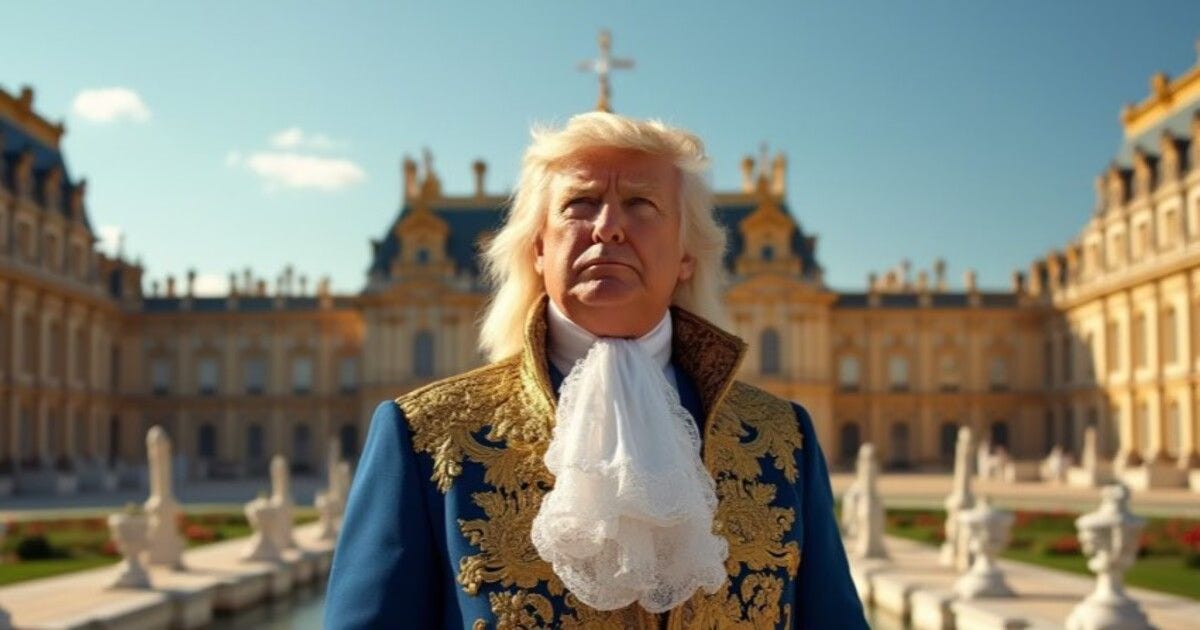
The phrase “I am the state” (L’État, c’est moi.) is traditionally attributed to Louis XIV, the seventeenth-century Sun King of France. This phrase has become synonymous with absolutism – the merging of state and ruler – and it is used in political theory as shorthand for personalist power. Unsurprisingly, Louis XIV and Trump have many things in common: The Palace of Versailles, just as the Trump Towers and the current “gilded renovations” in the White House, were both designed to overwhelm through their imposing architecture and gold-leafed walls and furniture; Louis used elaborate court ceremonies to impress the world, while Trump does the same through mass rallies and social-media fireworks; Louis saturated France with his face on coins, portraits, and statues, while Trump floods the digital sphere with his name, the praise others bestow upon him (occasionally he even refers to himself in the third person even in press conferences), and he has also created a digital coin with his face on it! This way, loyalty is directed not to institutions, but to the ruler’s vain persona.
Seen in this light, Trump’s renaming act, renovations, and personal cult, are not just innocuous idiosyncrasies. Coupled with his being surrounded by flatterers and yes-men (the “courtiers” of Louis XIV), this amounts to a new political reality that encloses a structural warning: By erasing the boundary between the individual and the state, he accelerates a political degeneration in which the United States drifts away from democracy and towards authoritarianism. What once relied on institutions, norms, and the rule of law is increasingly reorganized around Trump’s ego, narcissism, and transient impulses. This is how democracies gradually collapse, in full daylight, into rule by one.
*****
History may eventually restore proportion. With distance, future writers might articulate with clarity what feels impossible to fully convey now. Someday, the vocabulary may evolve to describe the present. Until then, those of us writing inside this unprecedented new reality must accept the mismatch. We write knowing our words will sound insufficient. Still, we write anyway as a form of catharsis. I, at least, regard this piece as a form of self-medication to preserve my sanity. It is also a self-reminder that what once was thought unthinkable is actually happening right now, before my very eyes.
For more Tuesday Letters on Substack, click here.
For more content, visit nicoshadjicostis.com.
Enjoying my Tuesday Letters? Check out my books, available at Amazon.com and your local bookstore by special order.

If you are not already a subscriber and you liked this essay, you may subscribe below to receive the bi-weekly Tuesday Letter.